import numpy as np

def m(X):
    return np.log(X)

def g(X):
    return X ** 2

def gen_data(n=500, seed=0, theta=5):
    np.random.seed(seed)
    V = np.random.normal(size=n, scale=2)
    U = np.random.normal(size=n, scale=3)
    X = np.random.uniform(size=n, low=1, high=10)
    D = m(X) + V
    Y = D * theta + g(X) + U
    X = X.reshape(-1, 1)
    return Y, D, X

Y, D, X = gen_data(seed=0)

import pandas as pd
import seaborn as sns
sns.pairplot(data=pd.DataFrame(dict(Y=Y, D=D, X=X.reshape(-1, ))))
<seaborn.axisgrid.PairGrid at 0x7fcd86a6be20>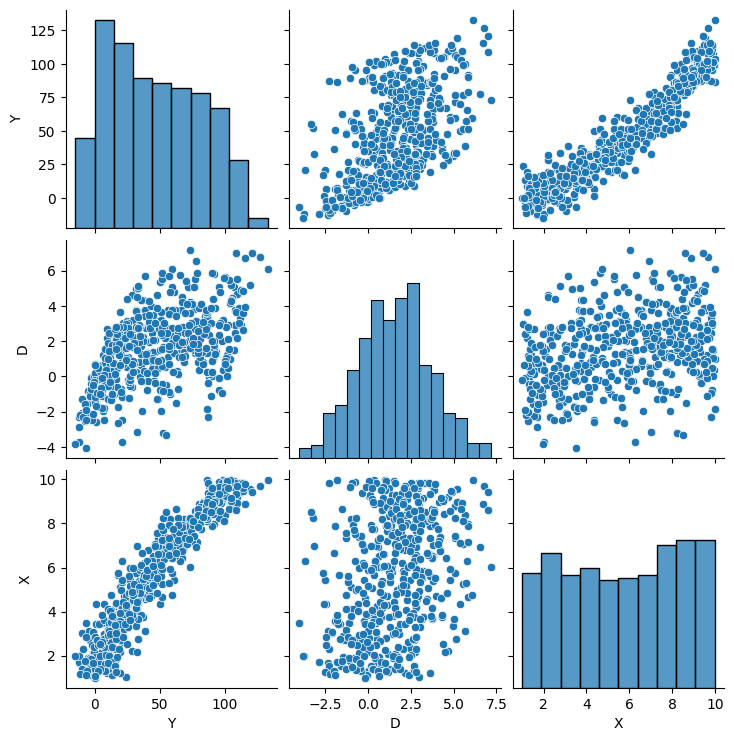
DML1を真似たやつ
サンプルを個に分割する。
について、番目のチャンクのサンプルのインデックスの集合をとする。のサンプルで局外関数の推定を行う:
のサンプルでを推定
の平均を集計
from lightgbm import LGBMRegressor
from sklearn.model_selection import KFold

def dml1(Y, D, X):
    kf = KFold(n_splits=5)
    kf.get_n_splits(X)
    thetas = []
    for i, (train_idx, test_idx) in enumerate(kf.split(X)):
        # 局外関数の推定
        m = LGBMRegressor(verbose=-1).fit(X[train_idx], D[train_idx])
        l = LGBMRegressor(verbose=-1).fit(X[train_idx], Y[train_idx])
        # 残差の計算
        V_hat = D[test_idx] - m.predict(X[test_idx])
        Y_res = Y[test_idx] - l.predict(X[test_idx])
        # θの推定
        theta_hat = np.mean(V_hat * V_hat) ** (-1) * np.mean(V_hat * Y_res)
        thetas.append(theta_hat)
    return np.mean(thetas)

dml1(Y, D, X)4.996210951148309DML
%%time
theta = 5
n_rep = 1000
estimation_errors = []
for i_rep in range(n_rep):
    Y, D, X = gen_data(seed=i_rep, theta=theta)
    theta_hat = dml1(Y, D, X)
    estimation_error = theta - theta_hat
    estimation_errors.append(estimation_error)

import matplotlib.pyplot as plt
fig, ax = plt.subplots()
ax.hist(estimation_errors, bins=30)
ax.set(xlabel=r"$\theta - \hat{\theta}$", title="Estimation Error")

mean_error = np.mean(estimation_errors)
ax.axvline(mean_error, color="darkblue")
ax.text(mean_error, 10, f" mean={mean_error:.2g}")

fig.show()
CPU times: user 18min 22s, sys: 8.91 s, total: 18min 31s
Wall time: 2min 20s
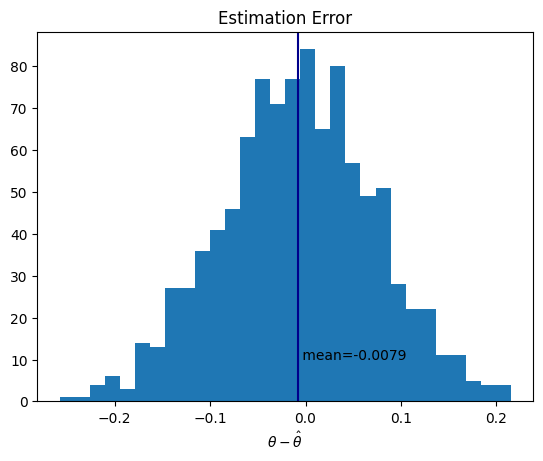
もしCross Fittingがなければ
def estimate_without_cross_fitting(Y, D, X):
    # 局外関数の推定
    m = LGBMRegressor(max_depth=4, verbose=-1).fit(X, D)
    l = LGBMRegressor(max_depth=4, verbose=-1).fit(X, Y)
    # 残差の計算
    V_hat = D - m.predict(X)
    Y_res = Y - l.predict(X)
    # θの推定
    theta_hat = np.mean(V_hat * V_hat) ** (-1) * np.mean(V_hat * Y_res)
    return theta_hat

estimate_without_cross_fitting(Y, D, X)4.8689337039631475%%time
n_rep = 1000
estimation_errors = []
for i_rep in range(n_rep):
Y, D, X = gen_data(seed=i_rep, theta=theta)
theta_hat = estimate_without_cross_fitting(Y, D, X)
estimation_error = theta - theta_hat
estimation_errors.append(estimation_error)
import matplotlib.pyplot as plt
fig, ax = plt.subplots()
ax.hist(estimation_errors, bins=30)
ax.set(xlabel=r"$\theta - \hat{\theta}$", title="Estimation Error (without splitting)")
mean_error = np.mean(estimation_errors)
ax.axvline(mean_error, color="darkblue")
ax.text(mean_error, 10, f" mean={mean_error:.2g}")
fig.show()CPU times: user 2min 39s, sys: 868 ms, total: 2min 40s
Wall time: 20.3 s
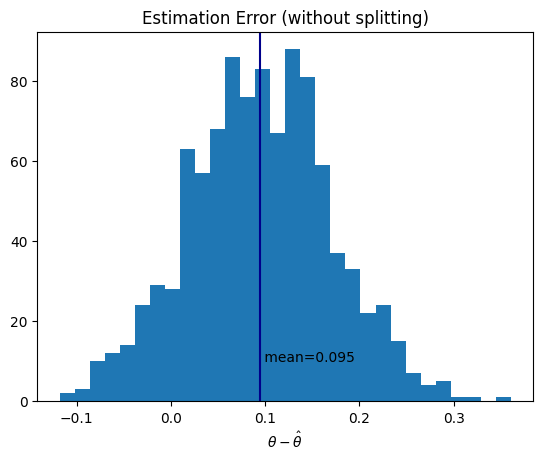
ライブラリと一致するか
theta = 7
Y, D, X = gen_data(seed=0, theta=theta)
theta_hat = dml1(Y, D, X)
print(f"{theta=:.1f}, {theta_hat=:.3f}")
theta=7.0, theta_hat=7.002
df = pd.DataFrame(X, columns=["x"])
df["y"] = Y
df["d"] = Y
df.head()
Loading...
l = LGBMRegressor(verbose=-1, n_estimators=100, max_depth=4)
m = LGBMRegressor(verbose=-1)

from doubleml import DoubleMLData
data = DoubleMLData(df, y_col="y", d_cols="d", x_cols=["x"])

from doubleml import DoubleMLPLR
np.random.seed(1)
dml = DoubleMLPLR(data, l, m)
dml.fit()
print(dml)
================== DoubleMLPLR Object ==================
------------------ Data summary ------------------
Outcome variable: y
Treatment variable(s): ['d']
Covariates: ['x']
Instrument variable(s): None
No. Observations: 500
------------------ Score & algorithm ------------------
Score function: partialling out
------------------ Machine learner ------------------
Learner ml_l: LGBMRegressor(max_depth=4, verbose=-1)
Learner ml_m: LGBMRegressor(verbose=-1)
Out-of-sample Performance:
Regression:
Learner ml_l RMSE: [[10.77148372]]
Learner ml_m RMSE: [[10.86900956]]
------------------ Resampling ------------------
No. folds: 5
No. repeated sample splits: 1
------------------ Fit summary ------------------
coef std err t P>|t| 2.5 % 97.5 %
d 0.989565 0.002293 431.535933 0.0 0.985071 0.99406
import numpy as np
np.random.seed(3141)
n_obs = 500
n_vars = 100
theta = 3
X = np.random.normal(size=(n_obs, n_vars))
d = np.dot(X[:, :3], np.array([5, 5, 5])) + np.random.standard_normal(size=(n_obs,))
y = theta * d + np.dot(X[:, :3], np.array([5, 5, 5])) + np.random.standard_normal(size=(n_obs,))

dml_data_sim = DoubleMLData.from_arrays(X, y, d)
print(dml_data_sim)
================== DoubleMLData Object ==================
------------------ Data summary ------------------
Outcome variable: y
Treatment variable(s): ['d']
Covariates: ['X1', 'X2', 'X3', 'X4', 'X5', 'X6', 'X7', 'X8', 'X9', 'X10', 'X11', 'X12', 'X13', 'X14', 'X15', 'X16', 'X17', 'X18', 'X19', 'X20', 'X21', 'X22', 'X23', 'X24', 'X25', 'X26', 'X27', 'X28', 'X29', 'X30', 'X31', 'X32', 'X33', 'X34', 'X35', 'X36', 'X37', 'X38', 'X39', 'X40', 'X41', 'X42', 'X43', 'X44', 'X45', 'X46', 'X47', 'X48', 'X49', 'X50', 'X51', 'X52', 'X53', 'X54', 'X55', 'X56', 'X57', 'X58', 'X59', 'X60', 'X61', 'X62', 'X63', 'X64', 'X65', 'X66', 'X67', 'X68', 'X69', 'X70', 'X71', 'X72', 'X73', 'X74', 'X75', 'X76', 'X77', 'X78', 'X79', 'X80', 'X81', 'X82', 'X83', 'X84', 'X85', 'X86', 'X87', 'X88', 'X89', 'X90', 'X91', 'X92', 'X93', 'X94', 'X95', 'X96', 'X97', 'X98', 'X99', 'X100']
Instrument variable(s): None
No. Observations: 500
------------------ DataFrame info ------------------
<class 'pandas.core.frame.DataFrame'>
RangeIndex: 500 entries, 0 to 499
Columns: 102 entries, X1 to d
dtypes: float64(102)
memory usage: 398.6 KB
from doubleml import DoubleMLPLR
np.random.seed(1)
dml = DoubleMLPLR(dml_data_sim, l, m)
dml.fit()
print(dml)
================== DoubleMLPLR Object ==================
------------------ Data summary ------------------
Outcome variable: y
Treatment variable(s): ['d']
Covariates: ['X1', 'X2', 'X3', 'X4', 'X5', 'X6', 'X7', 'X8', 'X9', 'X10', 'X11', 'X12', 'X13', 'X14', 'X15', 'X16', 'X17', 'X18', 'X19', 'X20', 'X21', 'X22', 'X23', 'X24', 'X25', 'X26', 'X27', 'X28', 'X29', 'X30', 'X31', 'X32', 'X33', 'X34', 'X35', 'X36', 'X37', 'X38', 'X39', 'X40', 'X41', 'X42', 'X43', 'X44', 'X45', 'X46', 'X47', 'X48', 'X49', 'X50', 'X51', 'X52', 'X53', 'X54', 'X55', 'X56', 'X57', 'X58', 'X59', 'X60', 'X61', 'X62', 'X63', 'X64', 'X65', 'X66', 'X67', 'X68', 'X69', 'X70', 'X71', 'X72', 'X73', 'X74', 'X75', 'X76', 'X77', 'X78', 'X79', 'X80', 'X81', 'X82', 'X83', 'X84', 'X85', 'X86', 'X87', 'X88', 'X89', 'X90', 'X91', 'X92', 'X93', 'X94', 'X95', 'X96', 'X97', 'X98', 'X99', 'X100']
Instrument variable(s): None
No. Observations: 500
------------------ Score & algorithm ------------------
Score function: partialling out
------------------ Machine learner ------------------
Learner ml_l: LGBMRegressor(max_depth=4, verbose=-1)
Learner ml_m: LGBMRegressor(verbose=-1)
Out-of-sample Performance:
Regression:
Learner ml_l RMSE: [[8.69278568]]
Learner ml_m RMSE: [[2.22238082]]
------------------ Resampling ------------------
No. folds: 5
No. repeated sample splits: 1
------------------ Fit summary ------------------
coef std err t P>|t| 2.5 % 97.5 %
d 3.48904 0.108446 32.172982 4.214560e-227 3.276489 3.701591