Skip to article frontmatterSkip to article content
Site not loading correctly?

This may be due to an incorrect BASE_URL configuration. See the MyST Documentation for reference.

練習問題メモ 02

和達三樹. (2019). 微分積分. 第3章 練習問題

[4] 次の関数のnn次導関数を求めよ

(1) y=1xy=\frac{1}{x}

y=x1y=x^{-1}なので

n=1n=1のとき、f(x)=1x2f'(x) = -1 \cdot x^{-2}

n=2n=2のとき、f(x)=1(2)x3f''(x) = -1 \cdot (-2) \cdot x^{-3}

n=3n=3のとき、f(3)(x)=1(2)(3)x4f^{(3)}(x) = -1 \cdot (-2) \cdot (-3) x^{-4}

n=4n=4のとき、f(4)(x)=1(2)(3)(4)x5f^{(4)}(x) = -1 \cdot (-2) \cdot (-3) \cdot (-4) x^{-5}

よって一般に

f(n)(x)=(1)nn!x(n+1)f^{(n)}(x) = (-1)^{n} n! x^{-(n+1)}

(2) y=ax(a>0)y=a^x \quad (a>0)

(ax)=axloga(a^x)' = a^x \log a
logy=xlogax=logyloga\log y = x \log a\\ \to x = \frac{\log y}{\log a}
dxdy=1ylogadydx=1/dxdy=yloga=axloga\frac{dx}{dy} = \frac{1}{y \log a}\\ \frac{dy}{dx} = 1 / \frac{dx}{dy}\\ = y \log a\\ = a^x \log a
(ax)=ax(loga)2(a^x)'' = a^x (\log a)^2
logy=xloga+loglogax=logyloglogaloga\log y' = x \log a + \log \log a\\ \to x = \frac{\log y' - \log\log a}{\log a}
dxdy=(logylogaloglogaloga)=1loga1y\frac{dx}{dy} = \left( \frac{\log y'}{\log a} - \frac{\log\log a}{\log a} \right)' = \frac{1}{\log a} \frac{1}{y}
dydx=1/dxdy=yloga=axlogaloga\frac{dy}{dx} = 1 / \frac{dx}{dy}\\ = y \log a\\ = a^x \log a \log a
f(n)(x)=dndxax=ax(loga)nf^{(n)}(x) = \frac{d^n}{dx} a^x = a^x (\log a)^n

(3) y=x2exy=x^2 e^x

ライプニッツの公式

(fg)(n)=k=0nnCkf(k)g(nk)(f g)^{(n)}=\sum_{k=0}^n{ }_n \mathrm{C}_k f^{(k)} g^{(n-k)}

を使って

(x2ex)(n)=k=0nnCk(x2)(k)(ex)(nk)=nC0(x2)(0)(ex)(n0)+nC1(x2)(1)(ex)(n1)+nC2(x2)(2)(ex)(n2)+nC3(x3)(3)(ex)(n3)+=n!0!(n0)!x2ex+n!1!(n1)!2xex+n!2!(n2)!2ex(x2 の 3階以上の微分は定数の微分になりゼロのため、以降の項は消える)=nnx2ex+n12xex+n(n1)22ex=x2ex+2nxex+n(n1)ex=ex{x2+2nx+n(n1)}\begin{align} (x^2 e^x)^{(n)} &= \sum_{k=0}^n { }_n C_k (x^2)^{(k)} (e^x)^{(n-k)}\\ &= { }_n C_0 (x^2)^{(0)} (e^x)^{(n-0)}\\ &\quad+ { }_n C_1 (x^2)^{(1)} (e^x)^{(n-1)}\\ &\quad+ { }_n C_2 (x^2)^{(2)} (e^x)^{(n-2)}\\ &\quad+ { }_n C_3 (x^3)^{(3)} (e^x)^{(n-3)}\\ &\quad+ \cdots \\ &= \frac{n!}{0!(n-0)!} x^2 e^x\\ &\quad + \frac{n!}{1!(n-1)!} 2x e^x\\ &\quad + \frac{n!}{2!(n-2)!} 2 e^x\\ &\quad (\because x^2 \text{ の 3階以上の微分は定数の微分になりゼロのため、以降の項は消える}) \\ &= \frac{n}{n} x^2 e^x\\ &\quad + \frac{n}{1} 2x e^x\\ &\quad + \frac{n (n-1)}{2} 2 e^x \\ &= x^2 e^x + 2nx e^x + n(n-1) e^x \\ &= e^x \{ x^2 + 2nx + n(n-1) \} \end{align}

[5]

[5] 助変数表示の微分 xxyy が 1 つの変数 tt の関数として x=f(t),y=g(t)x=f(t), y=g(t) の形で 与えられているとする. このとき, yyxx の関数, または xxyy の関数と考えてよく, tt を助変数(パラメータ)または媒介変数という. 逆関数の微分法を利用すれば,

dydx=dydtdtdx=dydtdxdt=g(t)f(t)\frac{d y}{d x}=\frac{d y}{d t} \frac{d t}{d x}=\frac{\frac{d y}{d t}}{\frac{d x}{d t}}=\frac{g^{\prime}(t)}{f^{\prime}(t)}

によって, 導関数を計算できる. これを用いて, 次の関数について, dy/dxd y / d x を求めよ.

(1) x=acost,y=bsintx=a \cos t, \quad y=b \sin t

dydt=bcostdxdt=asint\frac{dy}{dt} = b \cos t\\ \frac{dx}{dt} = - a \sin t\\

なので

dydx=dydtdxdt=bcostasint=bacott\frac{d y}{d x} = \frac{\frac{d y}{d t}}{\frac{d x}{d t}} = - \frac{b \cos t}{a \sin t} = - \frac{b}{a} \cot t

(2) x=3at1+t3,y=3at21+t3\displaystyle x=\frac{3 a t}{1+t^3}, \quad y=\frac{3 a t^2}{1+t^3}

dydt=(3at2)(1+t3)(3at2)(1+t3)(1+t3)2=6at(1+t3)3at23t2(1+t3)2=6at+6at49at4(1+t3)2=6at3at4(1+t3)2\frac{dy}{dt} = \frac{(3 a t^2)' (1+t^3) - (3 a t^2) (1+t^3)'}{ (1+t^3)^2 }\\ = \frac{6 a t (1+t^3) - 3 a t^2 \cdot 3t^2}{ (1+t^3)^2 }\\ = \frac{ 6at + 6at^4 - 9at^4}{ (1+t^3)^2 }\\ = \frac{ 6at - 3at^4}{ (1+t^3)^2 }\\
dxdt=(3at)(1+t3)3at(1+t3)(1+t3)2=3a(1+t3)3at3t2(1+t3)2=3a+3at39at3(1+t3)2=3a6at3(1+t3)2\frac{dx}{dt} = \frac{(3at)' (1+t^3) - 3at (1+t^3)'}{(1+t^3)^2}\\ = \frac{3a (1+t^3) - 3at \cdot 3t^2}{ (1+t^3)^2 }\\ = \frac{3a + 3a t^3 - 9at^3}{ (1+t^3)^2 }\\ = \frac{3a - 6at^3}{ (1+t^3)^2 }\\

なので

dydx=dydtdxdt=6at3at4(1+t3)23a6at3(1+t3)2=6at3at4(1+t3)2(1+t3)23a6at3=6at3at43a6at3=1/31/36at3at43a6at3=2atat4a2at3=a(2tt4)a(12t3)=2tt412t3=t(2t3)12t3\frac{d y}{d x} = \frac{\frac{d y}{d t}}{\frac{d x}{d t}} = \frac{ \frac{ 6at - 3at^4 }{ (1+t^3)^2} }{ \frac{ 3a - 6at^3 }{ (1+t^3)^2 } }\\ = \frac{ 6at - 3at^4 }{ (1+t^3)^2} \frac{ (1+t^3)^2 }{ 3a - 6at^3 }\\ = \frac{ 6at - 3at^4 }{ 3a - 6at^3 }\\ = \frac{ 1/3 }{ 1/3 } \frac{ 6at - 3at^4 }{ 3a - 6at^3 }\\ = \frac{ 2at - at^4 }{ a - 2at^3 }\\ = \frac{ a (2t - t^4) }{ a (1 - 2t^3) }\\ = \frac{ 2t - t^4 }{ 1 - 2t^3 }\\ = \frac{ t(2 - t^3) }{ 1 - 2t^3 }\\

[6]

[6] 双曲線関数

sinhx=exex2,coshx=ex+ex2,tanhx=sinhxcoshx\sinh x=\frac{e^x-e^{-x}}{2}, \quad \cosh x=\frac{e^x+e^{-x}}{2}, \quad \tanh x=\frac{\sinh x}{\cosh x}

に対して,次のことを示せ.

(1) ddxsinhx=coshx\frac{d}{d x} \sinh x=\cosh x

(2) ddxcoshx=sinhx\frac{d}{d x} \cosh x=\sinh x

(3) ddxtanhx=1cosh2x\frac{d}{d x} \tanh x=\frac{1}{\cosh ^2 x}

(1) ddxsinhx=coshx\frac{d}{d x} \sinh x=\cosh x

合成関数と捉えれば(e1x)=ex(e^{-1\cdot x})' = - e^{-x} なので

ddxsinhx=ddxexex2=ex+ex2=coshx\frac{d}{d x} \sinh x = \frac{d}{d x} \frac{e^x-e^{-x}}{2} = \frac{e^x+e^{-x}}{2} = \cosh x
memo
ddxsinhx=ddx(12ex12ex)\frac{d}{d x} \sinh x = \frac{d}{d x} \left( \frac{1}{2} e^x - \frac{1}{2} e^{-x} \right)\\

(2) ddxcoshx=sinhx\frac{d}{d x} \cosh x=\sinh x

合成関数と捉えれば(e1x)=ex(e^{-1\cdot x})' = - e^{-x} なので

ddxcoshx=ddxex+ex2=exex2=sinhx\frac{d}{d x} \cosh x = \frac{d}{d x} \frac{e^x+e^{-x}}{2} = \frac{e^x-e^{-x}}{2} = \sinh x

(3) ddxtanhx=1cosh2x\displaystyle \frac{d}{d x} \tanh x=\frac{1}{\cosh ^2 x}

(sinhxcoshx)=(sinhx)coshxsinhx(coshx)cosh2x=cosh2xsinh2xcosh2x=1cosh2x\left(\frac{\sinh x}{\cosh x}\right)' = \frac{(\sinh x)' \cosh x - \sinh x (\cosh x)'}{\cosh^2 x}\\ = \frac{\cosh^2 x - \sinh^2 x}{\cosh^2 x}\\ = \frac{1}{\cosh^2 x}\\
cosh2xsinh2x=1\cosh^2 x - \sinh^2 x = 1
cosh2xsinh2x=(coshx+sinhx)(coshxsinhx)=(ex+ex2+exex2)(ex+ex2exex2)=ex+ex+exex2ex+exex+ex2=2ex22ex2=exex=exx=1\begin{align} \cosh^2 x - \sinh^2 x &= (\cosh x + \sinh x)(\cosh x - \sinh x)\\ &= (\frac{e^x+e^{-x}}{2} + \frac{e^x-e^{-x}}{2}) (\frac{e^x+e^{-x}}{2} - \frac{e^x-e^{-x}}{2})\\ &= \frac{e^x+e^{-x} + e^x-e^{-x}}{2} \frac{e^x+e^{-x} - e^x+e^{-x}}{2}\\ &= \frac{2 e^x}{2} \frac{2 e^{-x}}{2}\\ &= e^x e^{-x}\\ &= e^{x-x}\\ &= 1 \end{align}

[7]

[7] 次の関数の極値を求め, そのグラフの概形をかけ.

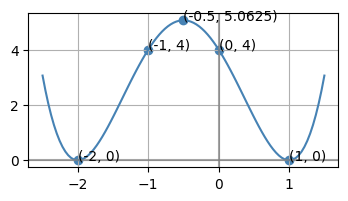
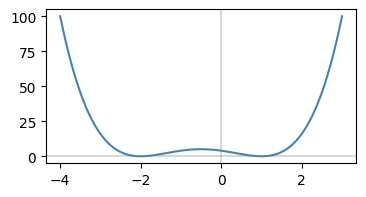
(1) f(x)=x4+2x33x24x+4f(x)=x^4+2 x^3-3 x^2-4 x+4

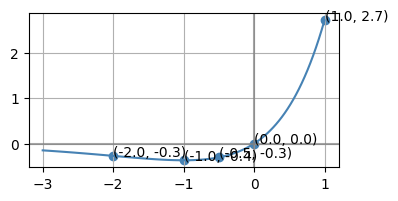
(2) f(x)=xexf(x)=x e^x

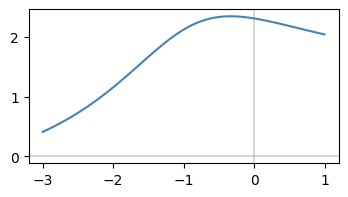
(3) f(x)=x+4x2+2x+3\displaystyle f(x)=\frac{x+4}{\sqrt{x^2+2 x+3}}

(1) f(x)=x4+2x33x24x+4f(x)=x^4+2 x^3-3 x^2-4 x+4

  1. 極値

f(x)=4x3+6x26x4=0f'(x) = 4 x^3 + 6 x^2 - 6 x - 4 = 0

となるxxを求める。

まず、因数(xa)(x-a)aaを探索する。

因数定理より、f(a)=0f(a) = 0となるaaがあれば(xa)(x - a)が因数になる。

a=1a=1とするとf(1)=4+664=0f'(1) = 4 + 6 - 6 - 4 = 0なので(x1)(x-1)が因数のひとつであることがわかった。

次に、組立除法で(4x3+6x26x4)/(x1)(4x^3 + 6x^2 - 6x - 4) / (x-1)を求める

4664410441040\begin{array}{ccc} 4 & 6 & -6 & -4\\ & 4 & 10 & 4\\ \hline 4 & 10& 4 & 0 \end{array}

より商の4x2+10x+44x^2 + 10x + 4と余り0が得られるので

f(x)=(x1)(4x2+10x+4)f'(x) = (x - 1)(4x^2 + 10x + 4)

4x2+10x+44x^2 + 10x + 4は、たすきがけ法などで解くと(4x+2)(x+2)(4x + 2)(x+2)なので

f(x)=(x1)(4x+2)(x+2)f'(x) = (x - 1)(4x + 2)(x + 2)

より、f(x)=0f'(x)=0となるxx2,1/2,1-2, -1/2, 1

極値のひとつは

f(2)=(2)4+2(2)33(2)24(2)+4=161612+8+4=0f(-2) = (-2)^4 + 2 (-2)^3 - 3 (-2)^2 - 4 (-2) + 4\\ = 16 - 16 - 12 + 8 + 4\\ = 0
  1. グラフ

f(3)=(3)4+2(3)33(3)24(3)+4=815427+12+4=16f(2)=(2)4+2(2)33(2)24(2)+4=161612+8+4=0f(1)=123+4+4=4f(1/2)=(1/2)4+2(1/2)33(1/2)24(1/2)+4=116218314+412+4=1161434+2+4=116+5f(0)=4f(1)=1+234+4=0\begin{align} f(-3) &= (-3)^4 + 2 (-3)^3 - 3 (-3)^2 - 4 (-3) + 4\\ &= 81 - 54 - 27 + 12 + 4\\ &= 16\\ \\ f(-2) &= (-2)^4 + 2 (-2)^3 - 3 (-2)^2 - 4 (-2) + 4\\ &= 16 - 16 - 12 + 8 + 4\\ &= 0\\ \\ f(-1) &= 1 - 2 - 3 + 4 + 4\\ &= 4\\ \\ f(-1/2) &= (-1/2)^4 + 2 (-1/2)^3 - 3 (-1/2)^2 - 4 (-1/2) + 4\\ &= \frac{1}{16} - 2 \frac{1}{8} - 3 \frac{1}{4} + 4 \frac{1}{2} + 4\\ &= \frac{1}{16} - \frac{1}{4} - \frac{3}{4} + 2 + 4\\ &= \frac{1}{16} + 5\\ \\ f(0) &= 4\\ f(1) &= 1 + 2 - 3 - 4 + 4\\ &= 0\\ \end{align}
Source
def f(x):
    return x**4 + 2*x**3 - 3*x**2 - 4*x + 4

import numpy as np
import matplotlib.pyplot as plt

X = [-2, -1, -1/2, 0, 1]
fig, ax = plt.subplots(figsize=[4,2])
for x in X:
    ax.scatter(x, f(x), color="steelblue")
    ax.text(x, f(x), f"{(x, f(x))}")

x = np.linspace(min(X)-0.5, max(X)+0.5, 100)
ax.plot(x, f(x), color="steelblue")

ax.axvline(0, color="gray", alpha=0.7)
ax.axhline(0, color="gray", alpha=0.7)
ax.grid(True)
fig.show()
<Figure size 400x200 with 1 Axes>
Source
import numpy as np
import matplotlib.pyplot as plt

x = np.linspace(-4, 3, 100)
fig, ax = plt.subplots(figsize=[4,2])
ax.plot(x, f(x), color="steelblue")
ax.axvline(0, color="gray", alpha=0.3)
ax.axhline(0, color="gray", alpha=0.3)
fig.show()
<Figure size 400x200 with 1 Axes>

(2) f(x)=xexf(x)=x e^x

  1. 極値

f(x)=1ex+xex=xex+ex=0x=exex=1f'(x) = 1 \cdot e^x + x e^x = x e^x + e^x = 0\\ \to x = \frac{-e^x}{e^x} = -1

f(x)=0f'(x)=0となるxx-1

極値は

f(1)=1e1=1e12.7180.368f(-1) = -1 e^{-1} = -\frac{1}{e} \approx -\frac{1}{2.718} \approx -0.368
  1. グラフ

f(2)=2e2=2e20.27f(1)=e1=1e0.37f(0)=0f(1)=e1=e2.72\begin{align} f(-2) &= -2e^{-2} = -\frac{2}{e^2} \approx -0.27\\ f(-1) &= -e^{-1} = - \frac{1}{e} \approx -0.37\\ f(0) &= 0\\ f(1) &= e^{1} = e \approx 2.72\\ \end{align}
- 2 / np.exp(2)
-0.2706705664732254
- 1 / np.exp(1)
-0.36787944117144233
Source
def f(x):
    return x * np.exp(x)


X = [-2, -1, -1/2, 0, 1]
fig, ax = plt.subplots(figsize=[4,2])
for x in X:
    ax.scatter(x, f(x), color="steelblue")
    ax.text(x, f(x), f"({x:.1f}, {f(x):.1f})")

x = np.linspace(-3, 1, 100)
ax.plot(x, f(x), color="steelblue")

ax.axvline(0, color="gray", alpha=0.7)
ax.axhline(0, color="gray", alpha=0.7)
ax.grid(True)
fig.show()
<Figure size 400x200 with 1 Axes>

(3) f(x)=x+4x2+2x+3f(x)=\frac{x+4}{\sqrt{x^2+2 x+3}}

f(x)=(x+4)(x2+2x+3)1/2f(x)= (x+4) (x^2 + 2x + 3)^{-1/2}

なので、

f(x)=(x+4)(x2+2x+3)1/2+(x+4)((x2+2x+3)1/2)=(x2+2x+3)1/212(x+4)(x2+2x+3)3/2\begin{align} f'(x) &= (x+4)' (x^2 + 2x + 3)^{-1/2} + (x+4) ((x^2 + 2x + 3)^{-1/2})'\\ &= (x^2 + 2x + 3)^{-1/2} - \frac{1}{2} (x+4) (x^2 + 2x + 3)^{-3/2}\\ \end{align}

となり、

(x2+2x+3)3/2=[(x+1)+2]3/2>0([(x+1)+2]xがなんであれ+2部分により>0のため)(x^2 + 2x + 3)^{-3/2} = [(x + 1) + 2]^{-3/2} > 0\\ (\because [(x + 1) + 2] は x がなんであれ +2 部分により >0 のため)

のため、

わからなかった

略解だとx=1/3x=-1/3

from sympy import symbols, factor
x = symbols("x")
y = (x**2 + 2*x + 3)**(-1/2) - (1/2) * (x+4) * (x**2 + 2*x + 3)**(-3/2)
factor(y)
Loading...
Source
import numpy as np
import matplotlib.pyplot as plt

def f(x):
    return (x+4)*(x**2 +2*x + 3)**(-1/2)

x = np.linspace(-3, 1, 100)
fig, ax = plt.subplots(figsize=[4,2])
ax.plot(x, f(x), color="steelblue")
ax.axvline(0, color="gray", alpha=0.3)
ax.axhline(0, color="gray", alpha=0.3)
fig.show()
<Figure size 400x200 with 1 Axes>