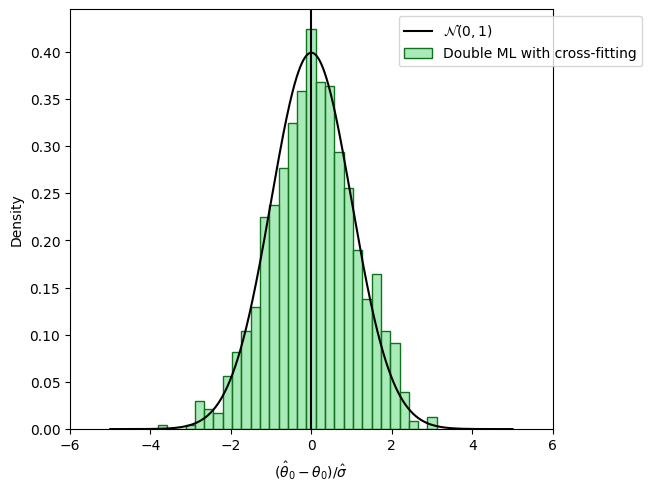
DoubleMLパッケージによるDMLのシミュレーション#
参考:Python: Basics of Double Machine Learning — DoubleML documentation
import warnings
import numpy as np
from scipy import stats
import matplotlib.pyplot as plt
import seaborn as sns

from lightgbm import LGBMRegressor
from sklearn.ensemble import RandomForestRegressor
from sklearn.model_selection import train_test_split
from sklearn.base import clone

from doubleml import DoubleMLData
from doubleml import DoubleMLPLR
from doubleml.datasets import make_plr_CCDDHNR2018

face_colors = sns.color_palette('pastel')
edge_colors = sns.color_palette('dark')

warnings.filterwarnings("ignore")

np.random.seed(1234)
n_rep = 1000
n_obs = 500
n_vars = 5
alpha = 0.5

data = list()

for i_rep in range(n_rep):
    (x, y, d) = make_plr_CCDDHNR2018(alpha=alpha, n_obs=n_obs, dim_x=n_vars, return_type='array')
    data.append((x, y, d))
naiive estimator#
\[
\hat{\theta}_0 = \left(\frac{1}{n} \sum_{i\in I} D_i^2\right)^{-1} \frac{1}{n} \sum_{i\in I} D_i (Y_i - \hat{g}_0(X_i)).
\]
def non_orth_score(y, d, l_hat, m_hat, g_hat, smpls):
    u_hat = y - g_hat
    psi_a = -np.multiply(d, d)
    psi_b = np.multiply(d, u_hat)
    return psi_a, psi_b
なお、\(\hat{g}_0(X)\)は直接推定できないため間接的に推定している
np.random.seed(1111)

ml_l = LGBMRegressor(n_estimators=300, learning_rate=0.1)
ml_m = LGBMRegressor(n_estimators=300, learning_rate=0.1)
ml_l = RandomForestRegressor(n_estimators=100, max_features=10, max_depth=5, min_samples_leaf=5)
ml_m = RandomForestRegressor(n_estimators=200, max_features=10, max_depth=5, min_samples_leaf=5)

ml_g = clone(ml_l)

theta_nonorth = np.full(n_rep, np.nan)
se_nonorth = np.full(n_rep, np.nan)

for i_rep in range(n_rep):
    print(f'Replication {i_rep+1}/{n_rep}', end='\r')
    (x, y, d) = data[i_rep]

    # choose a random sample for training and estimation
    i_train, i_est = train_test_split(np.arange(n_obs), test_size=0.5, random_state=42)

    # fit the ML algorithms on the training sample
    ml_l.fit(x[i_train, :], y[i_train])
    ml_m.fit(x[i_train, :], d[i_train])

    psi_a = -np.multiply(d[i_train] - ml_m.predict(x[i_train, :]), d[i_train] - ml_m.predict(x[i_train, :]))
    psi_b = np.multiply(d[i_train] - ml_m.predict(x[i_train, :]), y[i_train] - ml_l.predict(x[i_train, :]))
    theta_initial = -np.nanmean(psi_b) / np.nanmean(psi_a)
    ml_g.fit(x[i_train, :], y[i_train] - theta_initial * d[i_train])

    # create out-of-sample predictions
    l_hat = ml_l.predict(x[i_est, :])
    m_hat = ml_m.predict(x[i_est, :])
    g_hat = ml_g.predict(x[i_est, :])

    external_predictions = {
        'd': {
            'ml_l': l_hat.reshape(-1, 1),
            'ml_m': m_hat.reshape(-1, 1),
            'ml_g': g_hat.reshape(-1, 1)
        }
    }

    obj_dml_data = DoubleMLData.from_arrays(x[i_est, :], y[i_est], d[i_est])
    obj_dml_plr_nonorth = DoubleMLPLR(obj_dml_data,
                                    ml_l, ml_m, ml_g,
                                    n_folds=2,
                                    score=non_orth_score)
    obj_dml_plr_nonorth.fit(external_predictions=external_predictions)
    theta_nonorth[i_rep] = obj_dml_plr_nonorth.coef[0]
    se_nonorth[i_rep] = obj_dml_plr_nonorth.se[0]

fig_non_orth, ax = plt.subplots(constrained_layout=True);
ax = sns.histplot((theta_nonorth - alpha)/se_nonorth,
                color=face_colors[0], edgecolor = edge_colors[0],
                stat='density', bins=30, label='Non-orthogonal ML');
ax.axvline(0., color='k');
xx = np.arange(-5, +5, 0.001)
yy = stats.norm.pdf(xx)
ax.plot(xx, yy, color='k', label='$\\mathcal{N}(0, 1)$');
ax.legend(loc='upper right', bbox_to_anchor=(1.2, 1.0));
ax.set_xlim([-6., 6.]);
ax.set_xlabel('$(\hat{\\theta}_0 - \\theta_0)/\hat{\sigma}$');
plt.show()
Replication 1/1000
Replication 2/1000
Replication 3/1000
Replication 4/1000
Replication 5/1000
Replication 6/1000
Replication 7/1000
Replication 8/1000
Replication 9/1000
Replication 10/1000
Replication 11/1000
Replication 12/1000
Replication 13/1000
Replication 14/1000
Replication 15/1000
Replication 16/1000
Replication 17/1000
Replication 18/1000
Replication 19/1000
Replication 20/1000
Replication 21/1000
Replication 22/1000
Replication 23/1000
Replication 24/1000
Replication 25/1000
Replication 26/1000
Replication 27/1000
Replication 28/1000
Replication 29/1000
Replication 30/1000
Replication 31/1000
Replication 32/1000
Replication 33/1000
Replication 34/1000
Replication 35/1000
Replication 36/1000
Replication 37/1000
Replication 38/1000
Replication 39/1000
Replication 40/1000
Replication 41/1000
Replication 42/1000
Replication 43/1000
Replication 44/1000
Replication 45/1000
Replication 46/1000
Replication 47/1000
Replication 48/1000
Replication 49/1000
Replication 50/1000
Replication 51/1000
Replication 52/1000
Replication 53/1000
Replication 54/1000
Replication 55/1000
Replication 56/1000
Replication 57/1000
Replication 58/1000
Replication 59/1000
Replication 60/1000
Replication 61/1000
---------------------------------------------------------------------------
KeyboardInterrupt                         Traceback (most recent call last)
Cell In[3], line 22
     20 # fit the ML algorithms on the training sample
     21 ml_l.fit(x[i_train, :], y[i_train])
---> 22 ml_m.fit(x[i_train, :], d[i_train])
     24 psi_a = -np.multiply(d[i_train] - ml_m.predict(x[i_train, :]), d[i_train] - ml_m.predict(x[i_train, :]))
     25 psi_b = np.multiply(d[i_train] - ml_m.predict(x[i_train, :]), y[i_train] - ml_l.predict(x[i_train, :]))

File ~/work/notes/notes/.venv/lib/python3.10/site-packages/sklearn/base.py:1389, in _fit_context.<locals>.decorator.<locals>.wrapper(estimator, *args, **kwargs)
   1382     estimator._validate_params()
   1384 with config_context(
   1385     skip_parameter_validation=(
   1386         prefer_skip_nested_validation or global_skip_validation
   1387     )
   1388 ):
-> 1389     return fit_method(estimator, *args, **kwargs)

File ~/work/notes/notes/.venv/lib/python3.10/site-packages/sklearn/ensemble/_forest.py:487, in BaseForest.fit(self, X, y, sample_weight)
    476 trees = [
    477     self._make_estimator(append=False, random_state=random_state)
    478     for i in range(n_more_estimators)
    479 ]
    481 # Parallel loop: we prefer the threading backend as the Cython code
    482 # for fitting the trees is internally releasing the Python GIL
    483 # making threading more efficient than multiprocessing in
    484 # that case. However, for joblib 0.12+ we respect any
    485 # parallel_backend contexts set at a higher level,
    486 # since correctness does not rely on using threads.
--> 487 trees = Parallel(
    488     n_jobs=self.n_jobs,
    489     verbose=self.verbose,
    490     prefer="threads",
    491 )(
    492     delayed(_parallel_build_trees)(
    493         t,
    494         self.bootstrap,
    495         X,
    496         y,
    497         sample_weight,
    498         i,
    499         len(trees),
    500         verbose=self.verbose,
    501         class_weight=self.class_weight,
    502         n_samples_bootstrap=n_samples_bootstrap,
    503         missing_values_in_feature_mask=missing_values_in_feature_mask,
    504     )
    505     for i, t in enumerate(trees)
    506 )
    508 # Collect newly grown trees
    509 self.estimators_.extend(trees)

File ~/work/notes/notes/.venv/lib/python3.10/site-packages/sklearn/utils/parallel.py:77, in Parallel.__call__(self, iterable)
     72 config = get_config()
     73 iterable_with_config = (
     74     (_with_config(delayed_func, config), args, kwargs)
     75     for delayed_func, args, kwargs in iterable
     76 )
---> 77 return super().__call__(iterable_with_config)

File ~/work/notes/notes/.venv/lib/python3.10/site-packages/joblib/parallel.py:1986, in Parallel.__call__(self, iterable)
   1984     output = self._get_sequential_output(iterable)
   1985     next(output)
-> 1986     return output if self.return_generator else list(output)
   1988 # Let's create an ID that uniquely identifies the current call. If the
   1989 # call is interrupted early and that the same instance is immediately
   1990 # reused, this id will be used to prevent workers that were
   1991 # concurrently finalizing a task from the previous call to run the
   1992 # callback.
   1993 with self._lock:

File ~/work/notes/notes/.venv/lib/python3.10/site-packages/joblib/parallel.py:1914, in Parallel._get_sequential_output(self, iterable)
   1912 self.n_dispatched_batches += 1
   1913 self.n_dispatched_tasks += 1
-> 1914 res = func(*args, **kwargs)
   1915 self.n_completed_tasks += 1
   1916 self.print_progress()

File ~/work/notes/notes/.venv/lib/python3.10/site-packages/sklearn/utils/parallel.py:139, in _FuncWrapper.__call__(self, *args, **kwargs)
    137     config = {}
    138 with config_context(**config):
--> 139     return self.function(*args, **kwargs)

File ~/work/notes/notes/.venv/lib/python3.10/site-packages/sklearn/ensemble/_forest.py:189, in _parallel_build_trees(tree, bootstrap, X, y, sample_weight, tree_idx, n_trees, verbose, class_weight, n_samples_bootstrap, missing_values_in_feature_mask)
    186     elif class_weight == "balanced_subsample":
    187         curr_sample_weight *= compute_sample_weight("balanced", y, indices=indices)
--> 189     tree._fit(
    190         X,
    191         y,
    192         sample_weight=curr_sample_weight,
    193         check_input=False,
    194         missing_values_in_feature_mask=missing_values_in_feature_mask,
    195     )
    196 else:
    197     tree._fit(
    198         X,
    199         y,
   (...)
    202         missing_values_in_feature_mask=missing_values_in_feature_mask,
    203     )

File ~/work/notes/notes/.venv/lib/python3.10/site-packages/sklearn/tree/_classes.py:361, in BaseDecisionTree._fit(self, X, y, sample_weight, check_input, missing_values_in_feature_mask)
    355     raise ValueError(
    356         "Number of labels=%d does not match number of samples=%d"
    357         % (len(y), n_samples)
    358     )
    360 if sample_weight is not None:
--> 361     sample_weight = _check_sample_weight(sample_weight, X, DOUBLE)
    363 if expanded_class_weight is not None:
    364     if sample_weight is not None:

File ~/work/notes/notes/.venv/lib/python3.10/site-packages/sklearn/utils/validation.py:2181, in _check_sample_weight(sample_weight, X, dtype, copy, ensure_non_negative)
   2179 if dtype is None:
   2180     dtype = [np.float64, np.float32]
-> 2181 sample_weight = check_array(
   2182     sample_weight,
   2183     accept_sparse=False,
   2184     ensure_2d=False,
   2185     dtype=dtype,
   2186     order="C",
   2187     copy=copy,
   2188     input_name="sample_weight",
   2189 )
   2190 if sample_weight.ndim != 1:
   2191     raise ValueError("Sample weights must be 1D array or scalar")

File ~/work/notes/notes/.venv/lib/python3.10/site-packages/sklearn/utils/validation.py:1040, in check_array(array, accept_sparse, accept_large_sparse, dtype, order, copy, force_writeable, force_all_finite, ensure_all_finite, ensure_non_negative, ensure_2d, allow_nd, ensure_min_samples, ensure_min_features, estimator, input_name)
   1038 try:
   1039     warnings.simplefilter("error", ComplexWarning)
-> 1040     if dtype is not None and xp.isdtype(dtype, "integral"):
   1041         # Conversion float -> int should not contain NaN or
   1042         # inf (numpy#14412). We cannot use casting='safe' because
   1043         # then conversion float -> int would be disallowed.
   1044         array = _asarray_with_order(array, order=order, xp=xp)
   1045         if xp.isdtype(array.dtype, ("real floating", "complex floating")):

File ~/work/notes/notes/.venv/lib/python3.10/site-packages/sklearn/utils/_array_api.py:443, in _NumPyAPIWrapper.isdtype(self, dtype, kind)
    441 def isdtype(self, dtype, kind):
    442     try:
--> 443         return isdtype(dtype, kind, xp=self)
    444     except TypeError:
    445         # In older versions of numpy, data types that arise from outside
    446         # numpy like from a Polars Series raise a TypeError.
    447         # e.g. TypeError: Cannot interpret 'Int64' as a data type.
    448         # Therefore, we return False.
    449         # TODO: Remove when minimum supported version of numpy is >= 1.21.
    450         return False

File ~/work/notes/notes/.venv/lib/python3.10/site-packages/sklearn/utils/_array_api.py:234, in isdtype(dtype, kind, xp)
    232     return any(_isdtype_single(dtype, k, xp=xp) for k in kind)
    233 else:
--> 234     return _isdtype_single(dtype, kind, xp=xp)

File ~/work/notes/notes/.venv/lib/python3.10/site-packages/sklearn/utils/_array_api.py:246, in _isdtype_single(dtype, kind, xp)
    244     return dtype in {xp.uint8, xp.uint16, xp.uint32, xp.uint64}
    245 elif kind == "integral":
--> 246     return any(
    247         _isdtype_single(dtype, k, xp=xp)
    248         for k in ("signed integer", "unsigned integer")
    249     )
    250 elif kind == "real floating":
    251     return dtype in supported_float_dtypes(xp)

File ~/work/notes/notes/.venv/lib/python3.10/site-packages/sklearn/utils/_array_api.py:247, in <genexpr>(.0)
    244     return dtype in {xp.uint8, xp.uint16, xp.uint32, xp.uint64}
    245 elif kind == "integral":
    246     return any(
--> 247         _isdtype_single(dtype, k, xp=xp)
    248         for k in ("signed integer", "unsigned integer")
    249     )
    250 elif kind == "real floating":
    251     return dtype in supported_float_dtypes(xp)

File ~/work/notes/notes/.venv/lib/python3.10/site-packages/sklearn/utils/_array_api.py:242, in _isdtype_single(dtype, kind, xp)
    240     return dtype == xp.bool
    241 elif kind == "signed integer":
--> 242     return dtype in {xp.int8, xp.int16, xp.int32, xp.int64}
    243 elif kind == "unsigned integer":
    244     return dtype in {xp.uint8, xp.uint16, xp.uint32, xp.uint64}

File ~/work/notes/notes/.venv/lib/python3.10/site-packages/sklearn/utils/_array_api.py:381, in _NumPyAPIWrapper.__getattr__(self, name)
    361 # Data types in spec
    362 # https://data-apis.org/array-api/latest/API_specification/data_types.html
    363 _DTYPES = {
    364     "int8",
    365     "int16",
   (...)
    378     "complex128",
    379 }
--> 381 def __getattr__(self, name):
    382     attr = getattr(numpy, name)
    384     # Support device kwargs and make sure they are on the CPU

KeyboardInterrupt:
Overcoming regularization bias by orthogonalization#
orthogonalized regressor \(V=D-m(X)\)を用いる推定量
\[
\check{\theta}_0 = \left(\frac{1}{n} \sum_{i\in I} \hat{V}_i D_i\right)^{-1} \frac{1}{n} \sum_{i\in I} \hat{V}_i (Y_i - \hat{g}_0(X_i)).
\]
np.random.seed(2222)

theta_orth_nosplit = np.full(n_rep, np.nan)
se_orth_nosplit = np.full(n_rep, np.nan)

for i_rep in range(n_rep):
    print(f'Replication {i_rep+1}/{n_rep}', end='\r')
    (x, y, d) = data[i_rep]

    # fit the ML algorithms on the training sample
    ml_l.fit(x, y)
    ml_m.fit(x, d)

    psi_a = -np.multiply(d - ml_m.predict(x), d - ml_m.predict(x))
    psi_b = np.multiply(d - ml_m.predict(x), y - ml_l.predict(x))
    theta_initial = -np.nanmean(psi_b) / np.nanmean(psi_a)
    ml_g.fit(x, y - theta_initial * d)

    l_hat = ml_l.predict(x)
    m_hat = ml_m.predict(x)
    g_hat = ml_g.predict(x)

    external_predictions = {
        'd': {
            'ml_l': l_hat.reshape(-1, 1),
            'ml_m': m_hat.reshape(-1, 1),
            'ml_g': g_hat.reshape(-1, 1)
        }
    }

    obj_dml_data = DoubleMLData.from_arrays(x, y, d)

    obj_dml_plr_orth_nosplit = DoubleMLPLR(obj_dml_data,
                                        ml_l, ml_m, ml_g,
                                        score='IV-type')
    obj_dml_plr_orth_nosplit.fit(external_predictions=external_predictions)
    theta_orth_nosplit[i_rep] = obj_dml_plr_orth_nosplit.coef[0]
    se_orth_nosplit[i_rep] = obj_dml_plr_orth_nosplit.se[0]

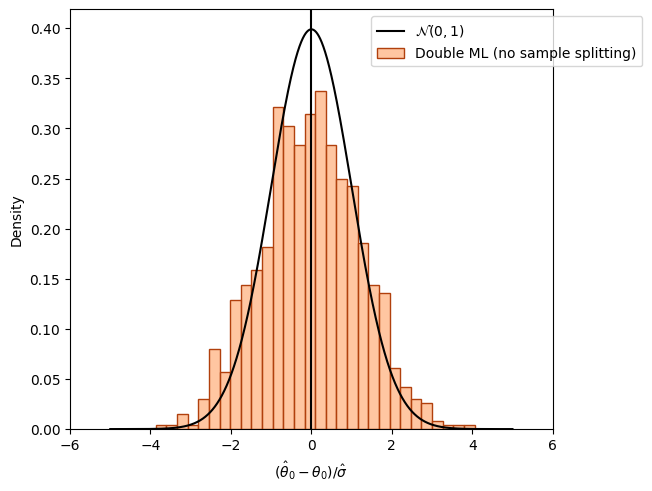
fig_orth_nosplit, ax = plt.subplots(constrained_layout=True);
ax = sns.histplot((theta_orth_nosplit - alpha)/se_orth_nosplit,
                color=face_colors[1], edgecolor = edge_colors[1],
                stat='density', bins=30, label='Double ML (no sample splitting)');
ax.axvline(0., color='k');
xx = np.arange(-5, +5, 0.001)
yy = stats.norm.pdf(xx)
ax.plot(xx, yy, color='k', label='$\\mathcal{N}(0, 1)$');
ax.legend(loc='upper right', bbox_to_anchor=(1.2, 1.0));
ax.set_xlim([-6., 6.]);
ax.set_xlabel('$(\hat{\\theta}_0 - \\theta_0)/\hat{\sigma}$');
plt.show()
Replication 1000/1000
Sample splitting to remove bias induced by overfitting#
np.random.seed(3333)

theta_dml = np.full(n_rep, np.nan)
se_dml = np.full(n_rep, np.nan)

for i_rep in range(n_rep):
    print(f'Replication {i_rep+1}/{n_rep}', end='\r')
    (x, y, d) = data[i_rep]
    obj_dml_data = DoubleMLData.from_arrays(x, y, d)
    obj_dml_plr = DoubleMLPLR(obj_dml_data,
                            ml_l, ml_m, ml_g,
                            n_folds=2,
                            score='IV-type')
    obj_dml_plr.fit()
    theta_dml[i_rep] = obj_dml_plr.coef[0]
    se_dml[i_rep] = obj_dml_plr.se[0]

fig_dml, ax = plt.subplots(constrained_layout=True);
ax = sns.histplot((theta_dml - alpha)/se_dml,
                color=face_colors[2], edgecolor = edge_colors[2],
                stat='density', bins=30, label='Double ML with cross-fitting');
ax.axvline(0., color='k');
xx = np.arange(-5, +5, 0.001)
yy = stats.norm.pdf(xx)
ax.plot(xx, yy, color='k', label='$\\mathcal{N}(0, 1)$');
ax.legend(loc='upper right', bbox_to_anchor=(1.2, 1.0));
ax.set_xlim([-6., 6.]);
ax.set_xlabel('$(\hat{\\theta}_0 - \\theta_0)/\hat{\sigma}$');
plt.show()
Replication 1000/1000